
2027-B09 Greener MOF nanogels for water remediation and critical mineral recovery
PROJECT HIGHLIGHTS
- Develop greener, recoverable MOF nanogels to remove persistent organic pollutants, heavy metals and dyes, and recover critical minerals.
- Reveal how structural and chemical transformations control performance from synthesis and gel formation through use, regeneration and disposal.
- Apply safe and sustainable by design principles to compare treatment efficiency, material release, aquatic effects and resource use.
Overview
Persistent organic pollutants, toxic metals and dyes threaten water quality, while discarded products and industrial residues contain valuable critical minerals. Sorbents can lose performance or release their own components as water chemistry changes. This project will develop greener metal–organic framework (MOF) nanogels and determine how their transformations govern remediation, resource recovery and environmental safety.
MOFs are porous solids with tunable binding sites. We will test whether confinement within hydrated biopolymer networks limits framework release while preserving accessible binding sites. You will prepare a small set of formulations using aqueous or reduced-solvent routes, then examine capture under different pH, dissolved organic matter and competing-ion conditions. Screening will cover persistent PFAS, represented by PFOA/PFOS, heavy metals and dyes. Detailed studies will focus on the most promising combinations. A separate pathway will test recovery of rare-earth elements, including neodymium and dysprosium, from secondary aqueous resources.
Building on our MOF remediation and transformation research, the project will connect structural and chemical changes to performance throughout synthesis, gelation, capture, regeneration and end-of-life ageing. Metal and linker release measurements, combined with pollutant mass balances, will identify potential secondary contamination. Mineral recovery will be assessed through desorption yield and product purity.
Safe and sustainable by design (SSbD) will guide material selection. You will compare treatment performance, aquatic effects, chemical and energy inputs, waste generation and reuse against relevant commercial sorbents. The outcome will be experimentally supported design rules for water treatment and resource recovery, identifying conditions that preserve useful performance while limiting environmental harm.
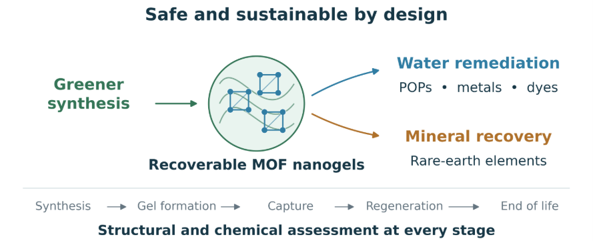
Figure 1. Proposed MOF nanogel pathways for remediation and mineral recovery, with structural and chemical assessment throughout the material life cycle.
Case Projects
This project does not offer a CASE studentship
Host
- University of Birmingham
Theme
- Climate and Environmental Sustainability, Organisms and Ecosystems
Supervisors
Project investigator
- Dr Swaroop Chakraborty (s.chakraborty@bham.ac.uk)
Co-investigators
- Prof Mohamed Abdallah (m.abdallah@bham.ac.uk); Dr Dominik Kubicki (d.j.kubicki@bham.ac.uk)
How to apply
Each host has a slightly different application process.
Find out how to apply for this studentship.
All applications must include the CENTA application form.
Methodology
Prepare up to four Fe/Zr/Cu MOF–biopolymer formulations using aqueous or reduced-solvent routes, retaining nanogel domains in recoverable carriers. Screen PFOA/PFOS, Pb/Cd and contrasting dyes; select two formulations for detailed studies on one organic pollutant and one metal. Study Nd/Dy recovery separately in synthetic feeds and a representative secondary-resource matrix. Track synthesis, gelation, conditioning, capture, regeneration and end-of-life ageing using diffraction, microscopy, vibrational spectroscopy, selected solid-state NMR and XAS where access permits. Quantify contaminants and metal/linker release by ICP-MS and validated chromatography. Include polymer-only, MOF-only, ion, commercial-sorbent and precipitation controls, independent batches and mass balances. Measure release and performance across five reuse cycles, together with mineral desorption and product purity. Algal and Daphnia screens, chemical, water and energy inventories, and a screening life-cycle comparison will guide SSbD decisions.
Training and skills
Partners and collaboration
Possible timeline
Further reading
Further details and How to Apply
For informal enquiries, contact Dr Swaroop Chakraborty, School of Geography, Earth and Environmental Sciences, University of Birmingham, Edgbaston, Birmingham B15 2TT, UK. Email: s.chakraborty@bham.ac.uk. Applicants with interests in environmental science, chemistry, materials science or related disciplines are encouraged to enquire. The project is suitable for full-time or part-time study, with laboratory arrangements agreed individually.
To apply to this project:
- You must include a CENTA studentship application form, downloadable from: CENTA Studentship Application Form 2027
- You must include a CV with the names of at least two referees (preferably three) who can comment on your academic abilities.
- Please submit your application and complete the host institution application process via: https://admissions.bham.ac.uk/course-finder-landing-page/?code=LES068 Please select the PhD in Geography (CENTA) 2027 entry year Apply Now button. The CENTA Studentship Application Form 2027 and CV can both be uploaded to the Personal Statement section of the online form. In the funding section of the online form please select Research Council Funding and then choose Natural Environment Research Council (NERC). Please quote CENTA 2027-B09 when completing the application form.
Applications must be submitted by 23:59 GMT on Wednesday 6th January 2027.