
PROJECT HIGHLIGHTS
- Environmental Pollution and Biodiversity: Tackling insecticide-driven insect decline by predicting how broad-spectrum insecticides harm pollinators and other beneficial insects, safeguarding ecosystem services in agricultural landscapes.
- Evolutionary Solutions for Safer Chemicals: Translating the ‘toxicity by descent’ framework into molecular docking predictions that identify vulnerable species and guide the design of insecticides with reduced environmental impact.
- Delivering Next-Generation Environmental Risk Assessment: A predictive, animal-sparing decision-support tool that helps regulators and industry prevent nontarget harm, advancing sustainable chemical safety.
Overview
Insect populations are declining worldwide, and agrochemical pollution is a principal driver. Current insecticide safety assessments underestimate environmental harm because they rely mainly on short-term mortality tests on a few surrogate species, most often honeybees, and overlook sublethal and community-level effects. The central environmental problem this project will solve is evolutionary: broad-spectrum insecticides—pyrethroids, neonicotinoids, organophosphates, carbamates and diamides—act on molecular targets conserved across the arthropod phylogeny, so pests, pollinators, natural predators and parasitoids share vulnerability through ‘toxicity by descent’. This project will deliver a predictive, evolution-informed molecular docking framework that protects beneficial insects by quantifying how sequence and structural divergence in insecticide target proteins translates into differential susceptibility across species. Key research questions are: (1) How does target-site divergence across arthropod phylogenies predict insecticide binding and toxicity? (2) Can molecular docking of representative insecticides against structurally modelled target proteins recapitulate documented resistance and species-sensitivity data? (3) Can the resulting framework guide selection of chemistries that spare vulnerable nontarget species and reduce environmental pollution?
To answer these questions, the project will compile target-protein sequences for five major insecticide classes across a phylogenetically representative panel of pests and beneficial arthropods, generate and refine structural models using homology modelling and AlphaFold, and run validated molecular docking pipelines against a panel of environmentally relevant insecticides. Predictions will be benchmarked against empirical resistance and sensitivity data from the literature and validated experimentally in Drosophila melanogaster and cell-based assays.
The outcomes are oriented directly to solving an environmental problem: a species-risk prioritisation framework and a cheminformatics tool that enable regulators and industry to identify at-risk species, avoid harmful chemistries and design safer insecticides, informing evidence-based risk assessment under the precautionary principle and contributing to halting insect declines.
The project will run over 3.5 years: Year 1 will focus on phylogenomic data assembly and structural modelling; Year 2 on docking pipeline development and benchmarking; Year 3 on experimental validation and case-study application with the industrial partner; the final six months on integration, thesis writing and dissemination.
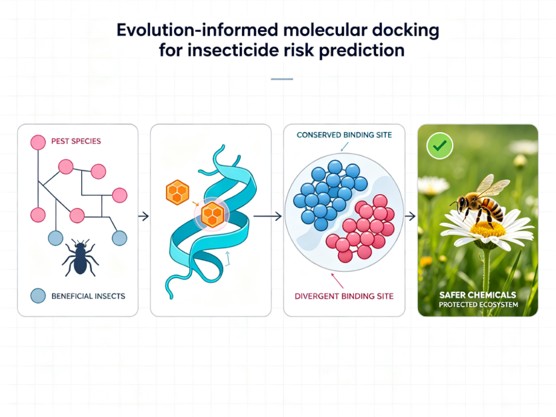
Figure 1: Evolution-informed molecular docking for predicting insecticide risk. Left, an arthropod phylogeny interweaving pest and beneficial species; centre, an insecticide molecule docked into a conserved insecticide target protein; right, conserved versus divergent binding-site residues that determine cross-species susceptibility; far right, the intended environmental solution—safer chemicals and protected ecosystems. The framework translates ‘toxicity by descent’—shared ancestry leading to shared chemical vulnerability—into prioritised predictions of nontarget risk, enabling proactive protection of biodiversity from insecticide pollution.
Case Projects
This project does not offer a CASE studentship
Host
University of Birmingham
Theme
Climate and Environmental Sustainability, Organisms and Ecosystems
Supervisors
Project investigator
Pu Xia (p.xia@bham.ac.uk)
Co-investigators
Scott Glaberman, University of Birmingham (s.glaberman@bham.ac.uk); Steve Short, UK Centre for Ecology & Hydrology (stesho@ceh.ac.uk)
How to apply
Each host has a slightly different application process.
Find out how to apply for this studentship.
All applications must include the CENTA application form.
Methodology
Target proteins of five major insecticide classes—voltage-gated sodium channels, nicotinic acetylcholine receptors, ryanodine receptors, acetylcholinesterase and chitin synthase—will be retrieved for a phylogenetically representative panel of pests, pollinators, predators and parasitoids. Orthology and sequence-divergence analyses will map target-site variation onto the arthropod phylogeny. Structural models will be generated by homology modelling and AlphaFold, and molecular docking (e.g., AutoDock Vina, Glide) will quantify binding of representative insecticides, with scoring calibrated against known resistance mutations (e.g., ace-1, kdr, ryanodine receptor) and empirical sensitivity data. Predictions will be validated using in vivo insects and in vitro bioassays where feasible. Outputs will be integrated into a species-risk prioritisation framework linking binding divergence to predicted susceptibility, giving regulators and industry an actionable, evolution-based tool to reduce insecticide harm to the environment.
Further details and How to Apply
Project contact: Dr Pu Xia, University of Birmingham (p.xia@bham.ac.uk).
To apply to this project:
- You must include a CENTA studentship application form, downloadable from: CENTA Studentship Application Form 2027
- You must include a CV with the names of at least two referees (preferably three) who can comment on your academic abilities.
- Please submit your application and complete the host institution application process via: https://admissions.bham.ac.uk/course-finder-landing-page/?code=LES068 Please select the PhD in School of Biosciences (CENTA) 2027 entry year Apply Now button. The CENTA Studentship Application Form 2027 and CV can both be uploaded to the Personal Statement section of the online form. In the funding section of the online form please select Research Council Funding and then choose Natural Environment Research Council (NERC). Please quote CENTA 2026-B06 when completing the application form.