
PROJECT HIGHLIGHTS
- We will test if trees have a molecular memory of past environmental stresses
- We will apply most advanced DNA sequencing approaches to investigate woods
- For the first time, we will explore relations between epigenetic and dendrochronology data in trees
Overview
Trees are long living, sessile organisms that represent a fundamental component of most of earth ecosystems. Being immobile during their life, trees need to efficiently adapt to changes of environment and to stresses, in order to reach maturity and reproduction.
Recent advanced in genomics studies are always more convincingly showing that environmental information can be recorded at molecular level on DNA through epigenetic marks. Epigenetics studies molecular changes of DNA (mostly DNA methylation) in response to developmental or environmental stimuli, which does not involve a change of the DNA sequence itself. These changes can be inherited during cell division and are particular stable in plants, where they represent the base of an epigenetic “memory”, which remains encoded in biological tissues and can be transmitted to progenies.
In trees, wood is produced by plant cells that lignified and die to provide physical functions such as of mechanical support, storage and water conduction. However, part of their DNA is preserved unaltered, and retains the epigenetic information encoded in the cells in the moment they died. In temperate zones, most trees produce in their wood one growth-ring each year, so that the entire period of a tree’s life remain impressed in its wood material. As wood growth is affected by environmental conditions, trees have marks of past interactions with the environment recorded into their wood as they grow, at both physical and molecular level. However, while physical propriety of tree rings is well investigated, the possible epigenetic changes associated to the residual DNA in different rings re.
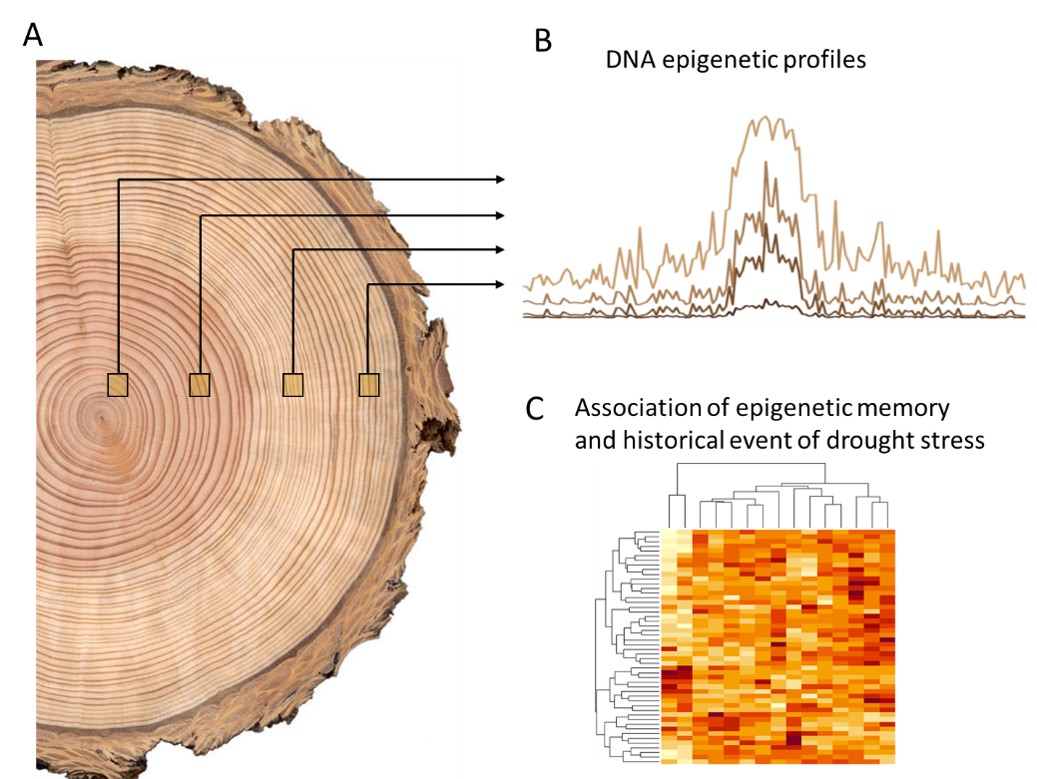
This project aims to understand how trees use environmental information to adapt to a changing condition. This will be done by extracting DNA from different parts of tree rings and compare their epigenetic profiles. The PhD researcher will compare the DNA methylation from different tree rings and associate epigenetic changes to historical and ecological record of drought. This will allow to connect tree molecular and physical responses to the environment in in tree rings, creating for the first time a direct connection among dendrochronology, ecology and epigenetic data in trees.
Figure: Conceptual scheme of the proposed work. A) collection of material B) epigenetic profiling and C) characterise the variation.
Case Projects
This project does not offer a CASE studentship
Host
- University of Birmingham
Theme
- Organisms and Ecosystems
Supervisors
Project investigator
- Marco Catoni, m.catoni@bham.ac.uk
Co-investigators
- Estrella Luna-Diez, E.LunaDiez@bham.ac.uk
How to apply
Each host has a slightly different application process.
Find out how to apply for this studentship.
All applications must include the CENTA application form.
Methodology
The project will require to merge molecular, computational, and ecological methodologies. We will adapt newly developed protocols of DNA extraction from oak wood to produce libraries for high-throughput sequencing analysis, to generate genome-wide single cytosine resolution maps of DNA methylation of wood cells located in different portion of a tree ring sample.
Then, we will analyse tree-rings from oak samples located at the BIFoR facility (University of Birmingham), for which historical records of past drought stress are available. We will determined physical changes in wood associated to drought stress and we will determine the associated portion of epigenetic changes found in each ring portion.
Finally, we will compare and validate our result with analysis performed on oak seedling drought stressed in controlled condition (greenhouses), to determine a final set of DNA regions that can be used to track past event of water deprivation in oak wood.
Further details and How to Apply
For any enquiries related to this project please contact Marco Catoni, University of Birmingham, m.catoni@bham.ac.uk. www.catonilab.com.
To apply to this project:
- You must include a CENTA studentship application form, downloadable from: CENTA Studentship Application Form 2027
- You must include a CV with the names of at least two referees (preferably three) who can comment on your academic abilities.
- Please submit your application and complete the host institution application process via: https://admissions.bham.ac.uk/course-finder-landing-page/?code=LES068 Please select the PhD in School of Biosciences (CENTA) 2027 entry year Apply Now button. The CENTA Studentship Application Form 2027 and CV can both be uploaded to the Personal Statement section of the online form. In the funding section of the online form please select Research Council Funding and then choose Natural Environment Research Council (NERC). Please quote CENTA 2027-B01 when completing the application form.
Applications must be submitted by 23:59 GMT on Wednesday 6th January 2027.