PROJECT HIGHLIGHTS
- Wildfire may fundamentally alter the microbial capacity of soils to consume atmospheric trace gases
- Combines field sampling, gas chromatography, mesocosms, metagenomics and stable-isotope probing to link environmental change with microbial function
- Determines whether pyrogenic carbon and organic amendments can enhance recovery of trace-gas oxidation after wildfire
Overview
Background
Wildfires are increasing in frequency and severity in many regions as a consequence of climate change 1. In addition to releasing large quantities of carbon dioxide, wildfires generate atmospheric trace gases including carbon monoxide (CO), methane (CH₄) and volatile organic compounds (VOCs) 2,3. The fate of these gases after deposition to soils is poorly understood, despite the potential importance of microbial trace-gas oxidation for atmospheric chemistry, soil carbon cycling and ecosystem recovery.
Wildfire substantially alters soil physicochemical properties and microbial communities through the loss and transformation of organic matter, formation of pyrogenic carbon, changes in pH and nutrient availability, and alterations in soil moisture and structure. These changes may strongly influence the capacity of soil microbial communities to consume atmospheric trace gases. Early studies have shown that organic amendments can increase soil atmospheric methane uptake in agricultural soils 4. However, we lack a mechanistic understanding of how wildfire severity and post-fire recovery affect microbial trace-gas oxidation.
This PhD will investigate how wildfire alters the capacity of soils to act as microbial sinks for atmospheric trace gases and whether this function can be enhanced during ecosystem recovery. It will examine interactions between fire severity, soil properties, pyrogenic carbon and trace-gas-oxidising microbial communities.
The research will employ a combination of gas measurements, soil mesocosm, and cutting-edge molecular techniques. DNA sequencing and metagenomic analyses will identify functional genes responsible for trace gas oxidation. Mesocosm experiments will test the effects of organic amendments on microbial activity and trace gas consumption, providing critical data on soil recovery and greenhouse gas mitigation.
Overall outputs:
The project will establish how wildfire affects soil trace-gas consumption and identify the microbial and environmental mechanisms underpinning this process. It will generate datasets linking fire severity, soil properties, microbial community composition and trace-gas oxidation, and provide a platform for future research on microbial ecosystem services and restoration of soil biogeochemical functions.
References:
[1] Kumar et al. 2019. Atmos Res 227:41-51. [2] Ciccioli et al 2014. Plant Cell Environ 37:1810-1825. [3] Gilman et al. 2015. Atmos Chem Phys 15:13915-13938. [4] Brenzinger et al. 2021. Biol Fertil Soils 57:1053-1074.
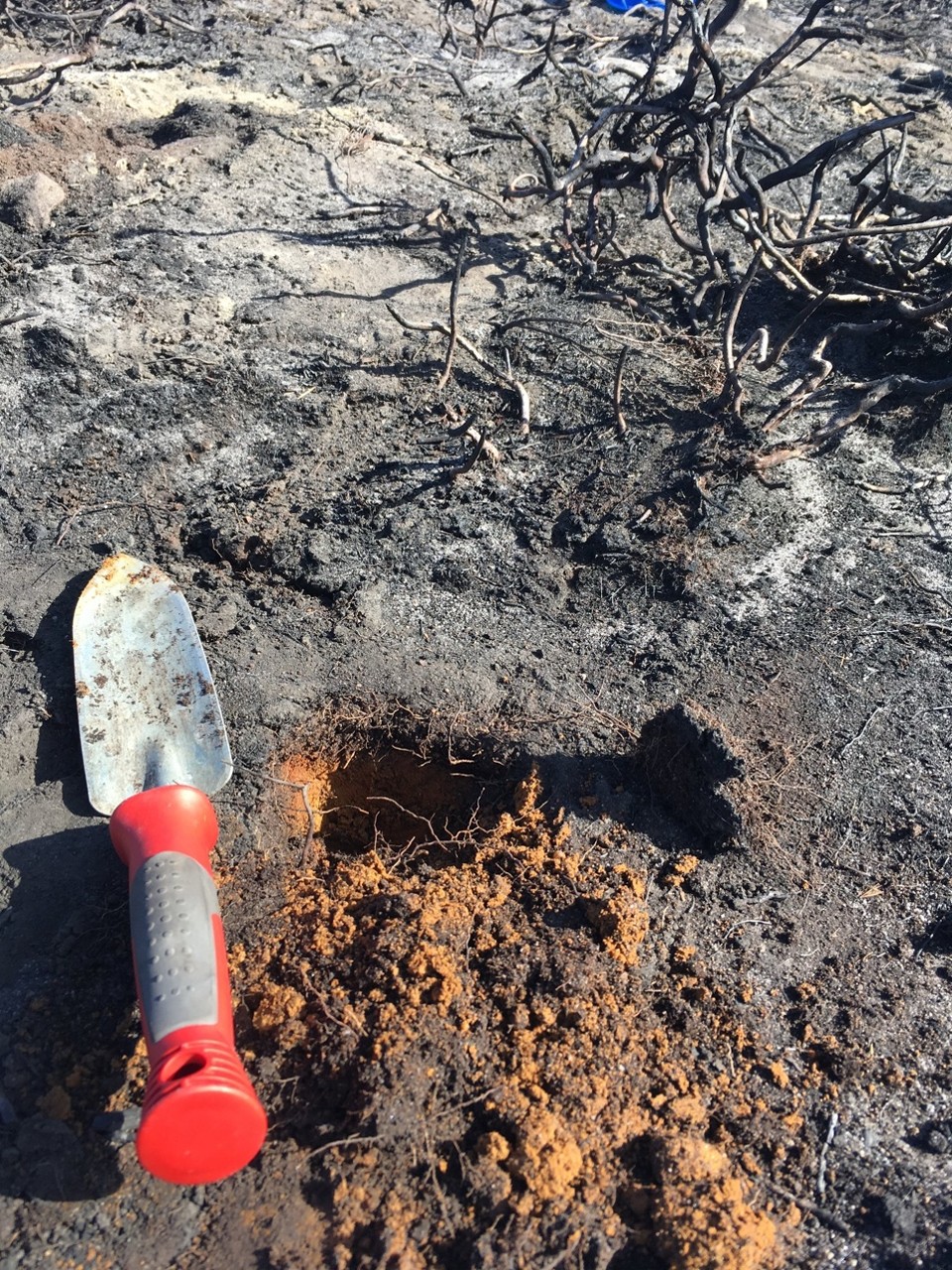
Figure 1: Wildfire-affected soil showing ash, charred organic matter and visible changes to the soil surface following fire disturbance
Case Projects
This project does not offer a CASE studentship
Host
- University of Birmingham
Theme
- Climate and Environmental Sustainability, Organisms and Ecosystems
Supervisors
Project investigator
- Dr Marcela Hernández García, m.t.hernandez@bham.ac.uk
Co-investigators
- Susheel Bhanu Busi, UK Centre for Ecology & Hydrology (UKCEH), SusBus@ceh.ac.uk
How to apply
Each host has a slightly different application process.
Find out how to apply for this studentship.
All applications must include the CENTA application form.
Methodology
Soils representing different wildfire severities and stages of post-fire recovery will be characterised for carbon content, pH, moisture and nutrient availability. CO and CH₄ consumption will be quantified using controlled incubations and gas chromatography, with selected VOCs investigated where appropriate. Soil mesocosms will test how pyrogenic carbon and selected organic amendments influence trace-gas oxidation and recovery of microbial activity. DNA sequencing, targeted molecular analyses and metagenomics will characterise microbial communities and functional potential for trace-gas oxidation. Stable-isotope probing will, where appropriate, identify microbial populations actively incorporating trace-gas-derived carbon and link microbial identity with function.
Further details and How to Apply
For any enquiries related to this project please contact Dr Marcela Hernández García, m.t.hernandez@bham.ac.uk.
To apply to this project:
- You must include a CENTA studentship application form, downloadable from: CENTA Studentship Application Form 2027
- You must include a CV with the names of at least two referees (preferably three) who can comment on your academic abilities.
- Please submit your application and complete the host institution application process via: https://admissions.bham.ac.uk/course-finder-landing-page/?code=LES068 Please select the PhD in School of Biosciences (CENTA) 2027 entry year Apply Now button. The CENTA Studentship Application Form 2027 and CV can both be uploaded to the Personal Statement section of the online form. In the funding section of the online form please select Research Council Funding and then choose Natural Environment Research Council (NERC). Please quote CENTA 2027-B04 when completing the application form.
Applications must be submitted by 23:59 GMT on Wednesday 6th January 2027.