2027-B19 Resolving the affinities of the earliest actinopterygian ‘macrodont’ radiations
PROJECT HIGHLIGHTS
- Actinopterygians account for over half of all living vertebrates, and underwent their first major radiation in the Carboniferous
- 3D X-ray imaging (CT scanning) of neglected fossils will provide new insights into the evolution of specialised ecological roles
- Revised hypothesis of relationships will provide a framework for interpreting patterns of survivorship and radiation across the End-Devonian Mass Extinction
Overview
Ray-finned fishes (Actinopterygii) are the most diverse group of vertebrates, accounting for over half of the >60,000 living vertebrate species. Although the group originated in the Devonian, most taxa from this period are morphologically conservative in overall size and shape, with very few exceptions. Ray-finned fishes exploded in taxonomic and morphological diversity in the Carboniferous, after the End-Devonian Mass Extinction, including the proliferation of diverse feeding strategies. This increase in morphological diversity and taxonomic richness has been interpreted as an adaptive radiation. Notable among these new forms are predatory, large-bodied, large-toothed ‘macrodont’ forms, an ecological category that is very rare in the Devonian. Despite an abundance of three-dimensional fossils, the anatomy and relationships of these macrodonts is poorly understood, presenting a barrier to understanding the evolutionary history of this specialised ecological role. A confused picture of relationships between lineages before and after the End-Devonian Mass Extinction also obscures patterns of survivorship and radiation. CT scanning will be used to target key taxa in order to resolve questions of phylogenetic affinity, clarifying whether the macrodont morphotype arose multiple times during the Palaeozoic diversification of actinopterygians and the innovations leading to their radiation. Although united by a common morphotype, different macrodont taxa show different specialisations of the teeth, jaws and internal cranial skeleton, hinting at varied ecological roles. Compilation of important geographic and environmental data will be used to investigate macroevolutionary patterns of dispersal and ecological expansion, including the contribution of macrodont actinopterygians to global trophic networks. In addition to resolving the long-standing puzzle of macrodont relationships, this project will have implications for understanding the radiation of actinopterygians in the aftermath of the End-Devonian Mass Extinction, building on the emerging picture of a more complicated pattern of extinction and recovery than previously thought.
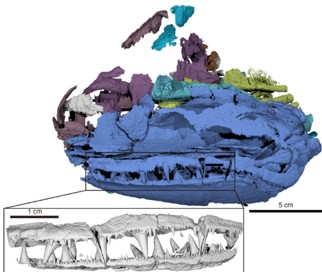
Figure 1: CT scan render of the skull and jaws of a Carboniferous macrodont actinopterygian.
Case Projects
This project does not offer a CASE studentship
Host
University of Birmingham
Theme
Organisms and Ecosystems
Supervisors
Project investigator
Sam Giles, s.giles.1@bham.ac.uk
Co-investigators
Richard Butler, University of Birmingham, r.butler.1@bham.ac.uk; Matt Friedman, University of Michigan, mfriedm@umich.edu
How to apply
Each host has a slightly different application process.
Find out how to apply for this studentship.
All applications must include the CENTA application form.
Methodology
This project incorporates descriptive, phylogenetic and quantitative techniques. Fossil taxa will be examined through a combination of traditional description and computed tomography (CT) scanning. The latter allows the internal and external anatomy of specimens to be investigated in a non-destructive manner. Three-dimensionally and exceptionally preserved taxa will be investigated using CT scanning. This new anatomical data will be incorporated into recent schemes of actinopterygian phylogeny, with maximum parsimony and Bayesian analysis used to investigate their position in the ray-finned fish tree of life. Macroevolutionary methods will be used to investigate broader patterns of evolution and dispersal.
Further details and How to Apply
For any enquiries related to this project please contact Sam Giles, s.giles.1@bham.ac.uk.
To apply to this project:
- You must include a CENTA studentship application form, downloadable from: CENTA Studentship Application Form 2027
- You must include a CV with the names of at least two referees (preferably three) who can comment on your academic abilities.
- Please submit your application and complete the host institution application process via: https://admissions.bham.ac.uk/course-finder-landing-page/?code=LES068 Please select the PhD in Geography (CENTA) 2027 entry year Apply Now button. The CENTA Studentship Application Form 2027 and CV can both be uploaded to the Personal Statement section of the online form. In the funding section of the online form please select Research Council Funding and then choose Natural Environment Research Council (NERC). Please quote CENTA 2027-B19 when completing the application form.
Applications must be submitted by 23:59 GMT on Wednesday 6th January 2027.