
PROJECT HIGHLIGHTS
- Develop new models of volcanic pulsing to explore the link between Large Igneous Provinces and severe environmental change
- Participation in the international IMPULSE and C-FORCE projects, working alongside a large Birmingham-led team of UK, EU and US-based researchers
- Opportunities to participate in ship- and land-based fieldwork to complement the main focus on coding and numerical model development
Overview
Throughout Earth’s history, episodic Large Igneous Provinces (LIPs) coincide with environmental crises including mass extinction, global warming and oceanic anoxia events. We cannot explain this coincidence because we do not know how LIPs that span 10 million years can trigger environmental crises that span 10 to 100 thousand years. Consequently, short environmental crises are often attributed to climate system tipping behaviour, when slow LIP magma and greenhouse gas emissions build to some critical threshold. This project investigates the alternative proposition that LIP magma and greenhouse gas emissions occur fast enough to explain the environmental crises directly, without climate system tipping.
Growing evidence suggests that LIP activity is strongly pulsed. The Birmingham-led IMPULSE project recently presented the most compelling evidence to date for pulsing within the Icelandic mantle plume from its inception to the present (Jones et al. 2026). A strong pulse of magma generated by the same mantle convection system could explain the Paleocene-Eocene Thermal Maximum global climate change event that accompanied the North Atlantic LIP (Jones et al. 2019; Voosen 2026). In parallel, high-resolution radiometric dating of the Deccan Traps LIP shows that a pulse of volcanic eruption spanning approximately 100 thousand years occurred immediately before the end-Cretaceous mass extinction (Schoene et al. 2019).
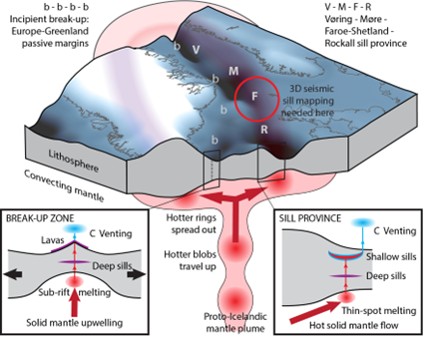
Figure 1: Conceptual model for how mantle plume pulsing might generate a short burst of greenhouse gas emissions. The sharpness of the leading edge of the hot blob is a key control on the timeframe of magma generation and consequent emissions. Modified from Jones et al. (2019).
Case Projects
This project does not offer a CASE studentship
Host
University of Birmingham
Theme
Climate and Environmental Sustainability, Dynamic Earth
Supervisors
Project investigator
Stephen M Jones (s.jones.4@bham.ac.uk)
Co-investigators
Anjali Piette (a.a.piette@bham.ac.uk); Manfredo Capriolo (m.capriolo@bham.ac.uk); Sarah Greene (s.e.greene@bham.ac.uk)
How to apply
Each host has a slightly different application process.
Find out how to apply for this studentship.
All applications must include the CENTA application form.
Methodology
The project will begin by gathering a comprehensive database to constrain temporal variations in volcanism within multiple LIPs. Datasets will include radiometric ages from LIP continental flood basalt lavas and shallow intrusions, as well as seismic records of variation in oceanic crustal thickness. We will use stochastic modelling techniques to calculate curves of magma volume through time for each LIP with uncertainty bounds, and compare the time-volume curves for different LIPs to establish the fundamental timescale(s) of volcanic pulsing.
The second stage consider the process which generates the pulses. We will focus on developing a numerical model for lithospheric thin spot melting to test whether observed pulsing trends can be explained by this mechanism (Figure 1). We will also consider alternative hypotheses that pulsing trends result from magma transport or eruption processes.
Further details and How to Apply
Prospective applicants are positively encouraged to contact Steve Jones (s.jones.4@bham.ac.uk) in advance of applying to ask questions about the project, discuss whether working with us on this project at the University of Birmingham is a good fit for you, or to ask questions about putting together a strong application. We are also happy to put you in contact with current and former students to ask questions about their experiences.
To apply to this project:
- You must include a CENTA studentship application form, downloadable from: CENTA Studentship Application Form 2027
- You must include a CV with the names of at least two referees (preferably three) who can comment on your academic abilities.
- Please submit your application and complete the host institution application process via: https://admissions.bham.ac.uk/course-finder-landing-page/?code=LES068 Please select the PhD in Geography (CENTA) 2027 entry year Apply Now button. The CENTA Studentship Application Form 2027 and CV can both be uploaded to the Personal Statement section of the online form. In the funding section of the online form please select Research Council Funding and then choose Natural Environment Research Council (NERC). Please quote CENTA 2027-B22 when completing the application form.
Applications must be submitted by 23:59 GMT on Wednesday 6th January 2027.