2027-B23 Functional morphology and ecology of the Pleistocene mammal fauna of Crete
PROJECT HIGHLIGHTS
- First detailed biomechanical study of the unique Cretan Pleistocene fauna
- Multi-angle investigation combining palaeontology, sedimentology, functional morphology, and biogeochemistry
- Fieldwork opportunities on Crete
Overview
Islands are often described as natural laboratories for evolution. Due to their isolation and constrained size, islands are ideal model systems to study evolution and ecological processes firsthand; for example, for studying island effects (or island rules), whereby animals become smaller due to spatial and resource limitations or larger due to the absence of predators and competition compared to their mainland counterparts.
The Mediterranean Islands are famous for their Cenozoic fauna. In particular, the Greek island of Crete is a treasure trove for studying unique animal assemblages. Its Pleistocene mammal fauna features an exceptional diversity of species that have undergone an astounding morphological transformation in adaptation to the changed geographical and environmental conditions: the smallest known mammoth (ca. 1 m shoulder height), dwarf elephants and hippos, several species of dwarf deer, but also giant rodents (rats and mice five to ten times the “normal” size) and otters. These extreme examples of dwarfism and gigantism were often accompanied by a radical change in habitat.
Although Cretan fossils have been studied for over hundred years, research predominantly focussed on descriptive/ taxonomic work, whereas functional and biogeochemical studies have been neglected. This project will focus on how a diverse range of species was able to adapt to their island habitat, not just once but several times which morphological changes allowed these animals to cope with fundamentally different environments.
As one of the best documented and diverse island faunas in the Mediterranean, Crete’s Pleistocene mammals provide an exceptional opportunity for a multi-disciplinary and multi-angle investigation on the adaptive evolution of the endemic island fauna from a palaeontological, biomechanical, and geochemical perspective. With over 100 recorded fossil localities and two independent phases of colonisation and adaptation events, Crete represents an ideal model system for this study.
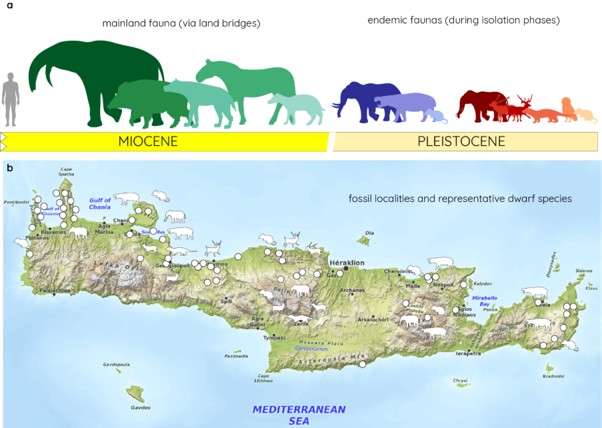
Figure 1: Different faunal assemblages during the Cenozoic on Crete (a) and distribution of fossil localities and representative dwarf species.
Case Projects
This project does not offer a CASE studentship
Host
University of Birmingham
Theme
Organisms and Ecosystems
Supervisors
Project investigator
Dr Stephan Lautenschlager (s.lautenschlager@bham.ac.uk)
Co-investigators
Dr James Bendle (University of Birmingham, j.bendle@bham.ac.uk); Prof Georgios Iliopoulos (University of Patras, iliopoulosg@upatras.gr)
How to apply
Each host has a slightly different application process.
Find out how to apply for this studentship.
All applications must include the CENTA application form.
Methodology
The PhD researcher will use a combination of digital reconstructions, computer simulations, geometric morphometric analysis, geochemical analyses, and evolutionary/ecological modelling. This will include, for example:
- Collecting morphometric and geometric morphometric data from fossil specimens, digital models, and literature sources
- Digitising specimens and generating digital models of selected fossil specimens
- Reconstruction of skeletal models and construction of biomechanical models for computer simulations
- Collecting geochemical data (stable oxygen, carbon, and strontium isotopes) from fossil tooth enamel and bone for isotope analyses
- Field work on Crete to collect new specimens
- A dedicated isotope geochemistry work package, co-supervised by Bendle, will generate high-resolution stable isotope profiles (δ¹⁸O and δ¹³C, with a targeted subset extended to ⁸⁷Sr/⁸⁶Sr) interpreted against ongoing Cretan environmental monitoring programme.
Further details and How to Apply
For any enquiries related to this project please contact Dr Stephan Lautenschlager (s.lautenschlager@bham.ac.uk).
To apply to this project:
- You must include a CENTA studentship application form, downloadable from: CENTA Studentship Application Form 2027
- You must include a CV with the names of at least two referees (preferably three) who can comment on your academic abilities.
- Please submit your application and complete the host institution application process via: https://admissions.bham.ac.uk/course-finder-landing-page/?code=LES068 Please select the PhD in Geography (CENTA) 2027 entry year Apply Now button. The CENTA Studentship Application Form 2027 and CV can both be uploaded to the Personal Statement section of the online form. In the funding section of the online form please select Research Council Funding and then choose Natural Environment Research Council (NERC). Please quote CENTA 2027-B23 when completing the application form.
Applications must be submitted by 23:59 GMT on Wednesday 6th January 2027.