2027-B34 Extreme climatic events in a warming world: understanding limits to resilience in freshwater ecosystems
PROJECT HIGHLIGHTS
- You will gain new insights into river ecosystem responses to climate extremes, including major droughts and heatwaves.
- You will have the opportunity to conduct innovative new flow experiments in state-of-the-art mesocosm facilities and undertake surveys of thermal tolerance in freshwater biota in streams across the UK.
- The project is co-created with CASE partner the Environment Agency and you will have an opportunity to take up a placement opportunity as well as benefit from end-user engagement.
- You will have the opportunity to collaborate with a large team of international scientists, including from the UK Centre of Ecology and Hydrology, exploring drought and temperature interactions in fresh waters.
Overview
Across the globe, extreme climatic events such as heatwaves and droughts have increased dramatically in frequency and intensity over the past 30 years, with potentially profound consequences for freshwater ecosystems. Repeated heatwave events have blighted the UK in 2026 yet very little is known about their effect on river life. Rare long-term studies suggest the impacts may be long-lasting and profound, but questions remain regarding the resistance and resilience of ecosystem to these recurrent events, especially when they occur together. During heatwaves, water temperature may approach or exceed the thermal tolerance limits of river organisms, leading to physiological stress, functional impairments and even local extinctions of sensitive species, but we do not know the tolerance limits of most British river fauna. In some regions, river flows are suffering drought and in extreme cases shifting from perennial to intermittent, modifying the ecological connectivity among habitats within the river network. Where low river flows persist, connections to riparian ecosystems are likely to be enhanced as terrestrial flora and fauna colonise the riverscape, altering biodiversity and the structure and function of food webs in unknown ways. Despite the growing prevalence of extreme climatic events, research on their effects in streams and rivers continues to lag far behind other environmental stressors (e.g. acid pulses or pesticides) and has focused on community level responses (e.g. species richness and abundances). Far less is known about impacts of interacting extremes on ecosystem functioning (e.g. production, decomposition, consumption) and food webs. Similarly, knowledge of the extent of ecosystem recovery of ecosystem to drought and heatwave pulses is poorly understood, and much research is needed to understand the vulnerability of key biological groups (e.g. invertebrates) to heatwaves in running waters across the UK.
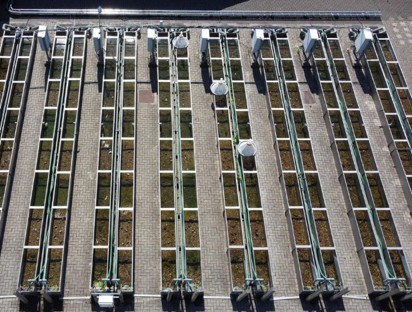
The successful candidate will join a team undertaking research to address these research gaps and will have the opportunity to conduct field surveys of thermal tolerance of key species across the UK along with flow / temperature manipulation experiments in a new state of the art mesocosm facility at the University of Birmingham (see Fig .1 below). These experiments will be combined with sampling and analysis of long-term records of flow, temperature and biodiversity in streams monitored by the Environment Agency, our project partner, in order to assess ecological resilience using time series data.
The results of the research will reveal how river biodiversity and ecosystem processes are affected by extreme events in an era of rapid global change, and will be used to help inform and guide climate change mitigation and adaptation policy.
Figure 1: You will have the opportunity to use artificial stream channels in the Ecolab facility on the University of Birmingham campus.
This project is a CENTA Flagship Project.
Case Projects
This project offers a CASE studentship
Host
- University of Birmingham
Theme
- Organisms and Ecosystems
Supervisors
Project investigator
- Mark Ledger (m.e.ledger@bham.ac.uk)
Co-investigators
- Kieran Khamis, University of Birmingham (k.khamis@bham.ac.uk); Kieran Gething, Environment Agency (Kieran.Gething@environment-agency.gov.uk)
How to apply
Each host has a slightly different application process.
Find out how to apply for this studentship.
All applications must include the CENTA application form.
Methodology
The project will test the effect of low flow and high temperature regimes on ecosystem functioning and food webs, including aquatic-terrestrial links. The doctoral researcher will:
- Have the opportunity to conduct research which might include field surveys to determine the thermal tolerance limits of invertebrates in streams of contrasting thermal profiles across the UK to understand species vulnerability to present and future warming events.
- Use artificial streams in the Birmingham EcoLaboratory facility (see Fig. 1 below) to replicate elements of natural flow regimes and simulate plausible future scenarios of occurrence (e.g. more frequent or intense events) of drought and heatwaves. State of the art sensor networks will monitor effects on water quality and ecosystem processes.
- Work with our Environment Agency colleagues to explore river temperature extremes in rivers across the UK and/or quantify the effects of drought on river ecosystems using historical data collected across the spectrum of UK river typologies.
Training and skills
Partners and collaboration
Possible timeline
Further reading
Further details and How to Apply
For any enquiries related to this project please contact:
Dr Mark Ledger:
https://www.birmingham.ac.uk/staff/profiles/gees/ledger-mark.aspx
Dr Kieran Khamis:
https://www.birmingham.ac.uk/staff/profiles/gees/khamis-kieran.aspx
Read about our EcoLaboratory:
https://www.birmingham.ac.uk/research/activity/ecolaboratory/index.aspx
To apply to this project:
- You must include a CENTA studentship application form, downloadable from: CENTA Studentship Application Form 2027
- You must include a CV with the names of at least two referees (preferably three) who can comment on your academic abilities.
- Please submit your application and complete the host institution application process via: https://admissions.bham.ac.uk/course-finder-landing-page/?code=LES068 Please select the PhD in Geography (CENTA) 2027 entry year Apply Now button. The CENTA Studentship Application Form 2027 and CV can both be uploaded to the Personal Statement section of the online form. In the funding section of the online form please select Research Council Funding and then choose Natural Environment Research Council (NERC). Please quote CENTA 2027-B34 when completing the application form.
Applications must be submitted by 23:59 GMT on Wednesday 6th January 2027.