
PROJECT HIGHLIGHTS
- Dams are critical for UK public water supply security, but outdated flow releases create water resourcing inefficiencies and degrade downstream river ecosystem health.
- The candidate will build a highly versatile and employable skillset centred on large-scale, ‘big data’ management and analyses, as well as fieldwork monitoring techniques in ecological sampling and hydrological assessments.
- This PhD focuses on delivering cutting-edge science to protect our rivers, helping to build more resilient ecosystems in the face of escalating climate change risks.
Overview
There are >3000 dams in the UK that provide >75% of national public drinking water supplies (1). These unnaturally transform river flow regimes, where typically fixed ‘compensation flows’ are released for most the year except when reservoir spillovers cause rapid downstream flushes. Excessive compensation flows can reduce water supply availability in the lead-up to and during drier month, which can trigger drought permits restricting public water use. Water supply dams also degrade river ecosystems dependent on natural flow variations where hydrological modifications can disrupt ecological processes like habitats, feeding patterns and migratory cues (2, 3, 4).
This PhD will aim to address these critical environmental and societal challenges by undertaking a multi-scaled approach across England. For this, the hydrological and ecological impacts of dams will first be assessed on a national-scale. This will then feed into regional evaluations, where the successful candidate will examine how dam flow release mechanisms are shaping water security and the ecological health in downstream environments. Optimal scenarios balancing these two demands (see 4, 5) will then be quantified across different climate change forecasts using state-of-the-art statistical analyses. Under supportive supervision, the student will become proficient in both hydrological and statistical modelling in order to achieve these goals.
While there is a national-scale, ‘big data’ focus for this PhD, the successful candidate will have the opportunity to collect field data from targeted study sites. This will not only provide additional evidence that may not be extractable from secondary datasets, but will also enhance the skills being assimilated by the student and allow them to glean greater insights into how river systems regulated by dams operate. More broadly, the successful candidate will draw on the expertise of the interdisciplinary supervisory team, who specialise translating scientific research to management solutions and work closely with water companies (2). These links to industry will help ensure that the outcomes of the PhD will translate to real-world action, where the findings will be shared with the water industry to help support dam flow release operations.
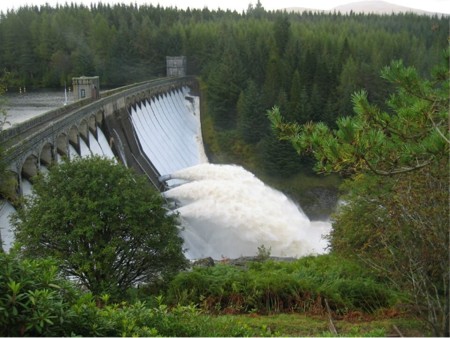
Figure 1: A dam releasing water downstream (Photo credit: Jennifer Jones).
This project is a CENTA Flagship Project.
Case Projects
This project does not offer a CASE studentship
Host
University of Birmingham
Theme
Climate and Environmental Sustainability, Organisms and Ecosystems
Supervisors
Project investigator
- Dr James C. White (j.c.white.1@bham.ac.uk)
Co-investigators
- Prof. David Hannah (University of Birmingham, d.m.hannah@bham.ac.uk);
- Dr Judy England (Environment Agency, judy.england@environment-agency.gov.uk);
- Dr Ponnambalam Rameshwaran (Centre for Ecology and Hydrology; ponr@ceh.ac.uk)
How to apply
Each host has a slightly different application process.
Find out how to apply for this studentship.
All applications must include the CENTA application form.
Methodology
Long-term hydrological (‘Hydrology Data Explorer’) and ecological (‘Fish and Ecology Data Explorer’; SHEBAM – (3)) national-scale datasets will be leveraged from the Environment Agency. These will be assessed alongside hydrological models (DECIPHeR – (1)) to quantify flow regime controls on ecological properties (‘flow-ecology relationships’). This will feed into regional case studies, where the candidate can collect additional ecohydrological data via bespoke fieldwork monitoring campaigns. For these, flow-ecology relationships will be constructed based on ‘business as usual’ dam flow releases and for hypothetical changes to this as part of environmental improvement plans. These will be explored across different UKCP18 climate change scenarios, and the impacts that all of these dam flow release scenarios have on water security will be quantified using DECIPHeR. Trade offs between ecological health and water security will be assessed to identify optimal solutions. These findings will be shared with water companies to help guide real-world management solutions.
Further details and How to Apply
For any enquiries related to this project please contact Dr James C. White (j.c.white.1@bham.ac.uk).
To apply to this project:
- You must include a CENTA studentship application form, downloadable from: CENTA Studentship Application Form 2027
- You must include a CV with the names of at least two referees (preferably three) who can comment on your academic abilities.
- Please submit your application and complete the host institution application process via: https://admissions.bham.ac.uk/course-finder-landing-page/?code=LES068 Please select the PhD in Geography (CENTA) 2027 entry year Apply Now button. The CENTA Studentship Application Form 2027 and CV can both be uploaded to the Personal Statement section of the online form. In the funding section of the online form please select Research Council Funding and then choose Natural Environment Research Council (NERC). Please quote CENTA 2027-B35 when completing the application form.
Applications must be submitted by 23:59 GMT on Wednesday 6th January 2027.